Know your CVE exposure, fix the ones that matter
bifrost starts from runtime. It learns what your containerised workloads do, gives each CVE a verdict, protects each workload with a tailored profile enforced at the kernel, and instantly knows your exposure to the next discovered vulnerability.
For containerised workloads running on Kubernetes, Docker Swarm or Nomad.




How bifrost works
From runtime up
Other tools start from the image or from a rulebook. bifrost starts from what each workload does when it runs, evaluates it, and builds every verdict, every profile and every answer on that.
- 01
Learn
Every container, down to what it does when it runs.
Every build, learned in pre-production: where it runs, what it contains, which CVEs it carries and what it does. Then evaluated for weaknesses.
- 02
Prioritise
Every CVE, with a verdict.
Every CVE gets a verdict against what actually runs: reachable, mitigated by the profile, or never loaded. No manual triaging.
- 03
Protect
Allow only what it does
A security profile for every workload, fresh with every build. In enforce mode, the kernel blocks anything outside it, including what an exploit not yet discovered would need.
- 04
Answer
The next CVE, assessed against what bifrost already knows.
When a new CVE is disclosed, bifrost assesses it against the context it already holds: protection status first, then where you have it, how exposed you are and what to do.
Workloads understood. CVEs prioritised. Boundaries enforced. New vulnerabilities assessed. Teams decide when to enforce; bifrost automates the recurring work.
Verdicts, not findings
Scanners report every CVE in the image. bifrost gives each one a verdict against what actually runs: never loaded, mitigated by the profile, or reachable. What is left for your team is the short list that matters.
bifrost does the triage. Engineering time goes to the short list, and every verdict arrives with the evidence behind it.
Why now
Security has to keep pace with what ships
Agents are changing how software gets built. Vulnerabilities are reported faster than anyone can triage them and exploited before a patch exists. Review and triage cannot be the only controls on what ships.
The difference is where each approach starts.
A scan starts from the build
Scan-led workflows start from build contents and known vulnerabilities. Without runtime context, your team still has to work out which findings matter in your deployment.
Detect and respond starts from the event
An essential layer that starts from suspicious activity and the response it needs. Responding to an event is not the same as constraining what a workload can do before it is exploited.
A rulebook needs an owner
Hand-maintained rules start from what someone writes, tests and updates every time the software changes. Manual regimes run from ~200 to 10,000 rules.
bifrost starts from runtime, learns and evaluates what each workload does, and allows only that: in enforce mode, the rest is refused before it runs. Every verdict comes from the same place as the protection: what the workload actually did when it ran.
See how it works45%
of AI-generated code ships with a security flaw, and newer, larger models are not getting safer.
Source: Veracode263%
Growth in reported vulnerabilities from 2020 to 2025. NIST's National Vulnerability Database can no longer enrich them all and now triages by priority.
Source: NIST−7days
Time-to-exploit has gone negative. Attackers weaponise vulnerabilities, on average, before a patch exists. In 2018 defenders had about 63 days.
Source: Mandiant
AI assesses, the kernel enforces. AI assesses each workload's behaviour for weaknesses, and how a CVE's exploit would meet what its profile allows. The profile and its enforcement are deterministic: no model decides at runtime whether an operation runs.
See it in the product
Every step, in one view
Every container, down to what it does
What each build contains, where it is deployed and what it does when it runs, down to its files, connections and system calls. Learned and evaluated automatically, with no code changes: bifrost flags weaknesses even in behaviour the workload needs.
How bifrost learns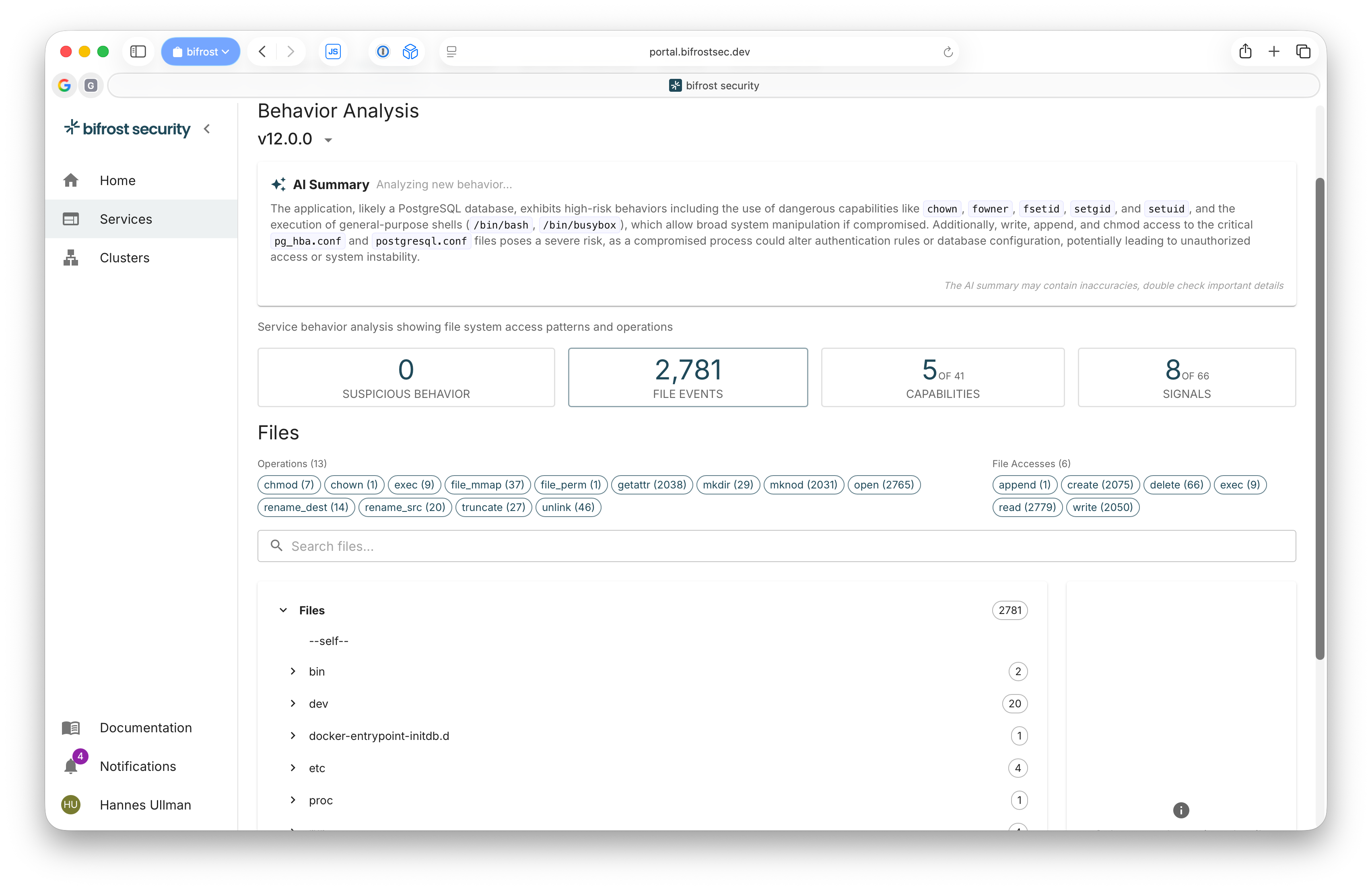
Every CVE, with a verdict
Reachable, mitigated by the profile, or never loaded. Thousands become a short list, with the evidence attached.
How verdicts are reached
Made to measure. Built to hold.
A tailored profile per workload, fresh with every build. In enforce mode the kernel blocks anything outside it, and every blocked action arrives with its context: which workload, which build, and what was refused.
How the profile protects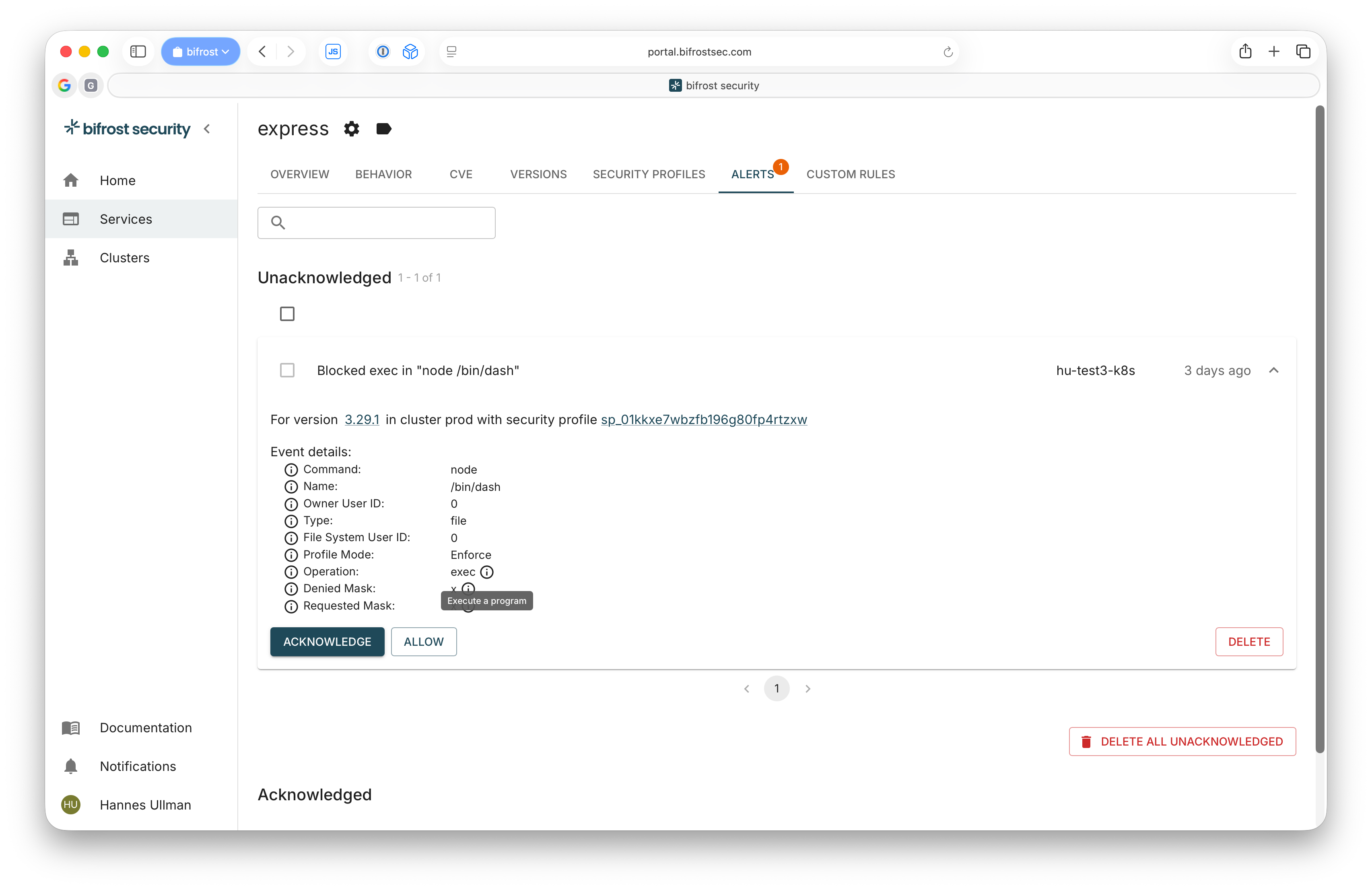
Protection, not just detection
Same container, same exploit, two outcomes
A Node.js application with a newly discovered vulnerability, attacked twice with the same request. Once as it ships. Once with the profile bifrost generated for that build, in enforce mode.
Without bifrost
A foothold
The exploit gives the attacker a root shell inside the container, and every path that starts there: secrets, the database, the next service. Detection, where it is in place, reports it afterwards, once the shell is already open.
With bifrost
Refused, and reported
With a tailored bifrost profile, the workload is allowed only the behaviour it needs and denied everything else. A shell was never part of it, so the kernel refuses the exec before it runs and the exploit fails. The attacker has no room to move, and the alert arrives with pod, image and the denied action.
Hardened before the patch. In enforce mode, the kernel blocks every operation outside the profile, including the shell this exploit needed. The bug still needs a patch, and the profile holds while your team prepares and deploys it.
Works with your stack
For containerised workloads running on Kubernetes, Docker Swarm or Nomad.
On Kubernetes, one Helm chart: a first assessment of CVE exploitability in under 10 minutes.
Verdicts and blocked actions go back to whoever writes the next change, in Slack, Microsoft Teams or a webhook.

Kubernetes
Platform
Docker
Platform

Google GKE
Cloud

Azure AKS
Cloud

OVHcloud
Cloud

AWS EKS
Cloud

DigitalOcean
Cloud

GitHub Actions
CI/CD

ArgoCD
GitOps

Helm
Packaging

Talos Linux
Operating System

Ubuntu
Operating System
The next incident, analysed
Breakdowns of major vulnerabilities and breaches, and runtime security thinking from the bifrost team. About twice a month.
A lookup, not a war room
Protection status first, then scope and next action. See it on your stack: a 30-minute demo, or 14 days on your own cluster.