The outcomes of running bifrost in a CRA world
What actually changes for a security team once a runtime-driven platform meets the Cyber Resilience Act: a smaller backlog, self-generating evidence, a 24-hour reporting clock you can hit, and metrics that mean something to a board.

Hannes Ullman
bifrost security
Part 3 of 3 in the Cyber Resilience Act series.
The first post described the Cyber Resilience Act in plain terms. The second walked through where a runtime-driven platform maps to its obligations. This last post is the one that matters most to a CISO: what actually changes once you are running this way?
CRA is a forcing function. It will pull every product company in the EU market through a set of operational changes. The question is whether you bleed engineering hours into manual evidence collection, or come out the other side with a security programme that runs faster than before. The outcomes below are the ones worth committing to.
A vulnerability backlog small enough to actually move
The biggest cost of CRA-style vulnerability handling is the backlog. Modern scanners produce thousands of findings across applications, workloads and services, and triaging by CVSS alone is how good security teams end up exhausted and slow.
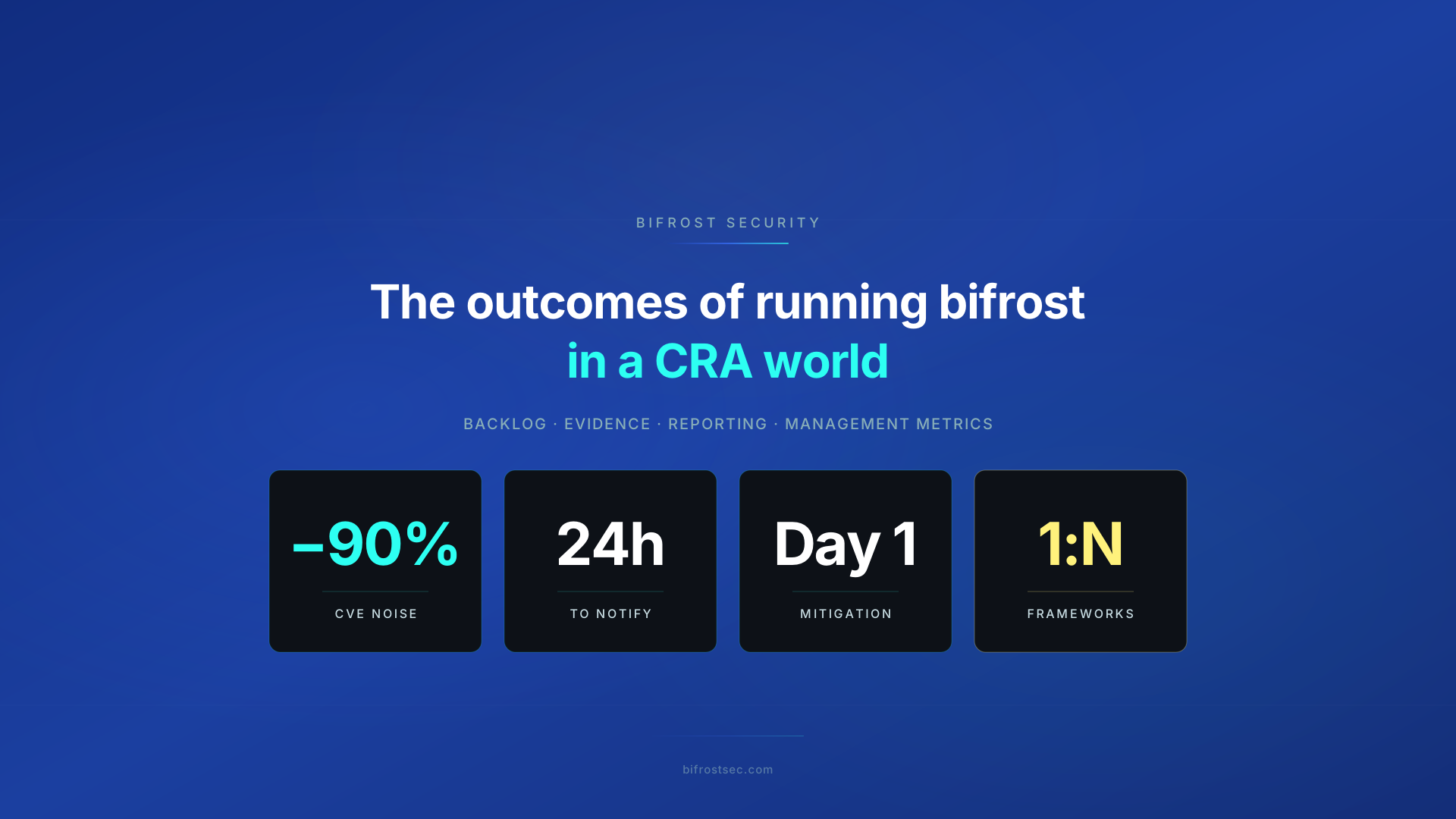
Runtime reachability changes the maths. When bifrost ingests an SBOM and correlates each CVE against the runtime profile, vulnerabilities in unused code paths and behind blocked system calls drop to low priority automatically, with a defensible reason recorded. In production we see CVE noise reduction of up to 90%. That is the difference between a queue your team works through and a queue they ignore. For the CRA “address vulnerabilities without delay” obligation, the vulnerabilities that matter get attention because they are no longer buried.
Evidence that generates itself
The expensive part of an audit is the four weeks before it, when engineers stop building and start writing documents. CRA increases the documentation surface (SBOMs per version, risk assessments, descriptions of security measures, blocked-event records) and does so across the entire support period of every product.
The version of this that doesn’t consume your engineering team is the one where evidence is a byproduct of normal operation. bifrost stores SBOMs as you ship them, regenerates profiles on every deployment, and logs every blocked event with full context. When the question “show us how you managed vulnerabilities for product X over the last 12 months” arrives, the answer is an export, not a project. The narrative shifts from “trust our process” to “here is the data.”
A faster reporting clock you can actually meet
From 11 September 2026, the 24-hour early-warning notification is a real obligation. Most security teams do not have a rehearsed path from “we just learned of an actively exploited vulnerability” to “a notification is in the ENISA Single Reporting Platform.”
Runtime evidence shortens that path. A runtime violation is evidence of exploitation, or of an attempt at it. The blocked-event stream tells you what was attempted, on which version, in which environment, and whether the runtime profile already neutralised it. That is most of the content the regulator wants. With a defined on-call workflow, the 24-hour clock stops being terrifying.
Day-one protection during the patching window
When a new CVE drops mid-week, “we will patch it Friday” is no longer defensible if the vulnerability is exploitable in your product. But Friday-patching is sometimes the only realistic engineering option.
A least-privilege runtime profile changes the conversation. If the attack vector requires a system call your profile blocks, the vulnerability is mitigated in production before any code change ships. You still patch, on a sane schedule rather than at 11pm on a Tuesday. CRA expects vulnerabilities to be addressed effectively, and runtime mitigation is one of the most honest forms of effective handling.
Management-ready metrics, instead of risk theatre
CRA invites a different conversation with management. Instead of reporting CVE counts and CVSS averages, numbers that grow forever and mean less than they should, runtime intelligence gives you metrics that move in the right direction:
- the size of the reachable CVE backlog at the end of the period, and how it has moved since the last one;
- mean time to remediate for reachable vulnerabilities, separated from the theoretical ones;
- coverage percentage across production workloads;
- the number of CVEs neutralised at runtime without a code change.
These are KPIs that pass the “what does this actually mean?” test, and they correspond directly to obligations in Annex I, including minimising attack surface, reducing incident impact, and addressing vulnerabilities without delay.
A position that survives the next regulation
CRA is the first horizontal product-cybersecurity regulation in the EU. It will not be the last. NIS2 already overlaps, DORA does for financial services, and sector regulations on AI, medical devices, automotive, and energy keep landing.
The teams that come out of this calmly are the ones who built a single internal control layer that satisfies several frameworks at once. Runtime profiling and SBOM-with-reachability fit: one set of technical controls maps to CRA Annex I, NIS2 Article 21, DORA ICT-risk requirements, SOC 2 CC6.1, ISO 27001 Annex A access controls, and PCI DSS least-privilege clauses. Build the layer once, demonstrate against every framework that asks.
Where to start
CRA does not reward heroics. It rewards organisations whose normal operating state produces the artefacts the regulation asks for. The way you get there is to put the controls in the runtime, treat the evidence as a side-effect, and use the time you save to focus on the vulnerabilities that genuinely matter.
We built bifrost to make that the default. If you are running container workloads in the EU and want to see the picture against your own services, the trial spins up in under 10 minutes. CRA is a deadline. It is also an opportunity to fix something that has been slowly breaking for years.
Series complete. Part 1: The Cyber Resilience Act, in plain terms. Part 2: How bifrost maps to the Cyber Resilience Act. Part 3 (this post): The outcomes of running bifrost in a CRA world.
Tags
Do you know what's exploitable in your environment?
Deploy bifrost via Helm and it reads how every container is actually deployed, cutting your CVE list before a single line of code changes.