You used to have two months to fix a security flaw. With AI, you have hours.
Attackers now exploit flaws before fixes exist, and CVE volumes have nearly doubled. Why defenders should start from how their own software behaves, and four questions leadership should be able to answer within an hour.

Hannes Ullman
bifrost security
When a new security flaw becomes public, the routine is familiar. Find out whether it affects you, work out whether it can be exploited, and fix it without disrupting the business. But the time you have to do it is shrinking.
In 2018, attackers started exploiting a flaw on average about two months after the fix was released. Today they start on average a week before the fix exists, according to Google’s security firm Mandiant.
AI works for both sides
AI helps developers ship far more code, and it helps researchers find flaws that people have missed for years. Attackers have the same tools. They no longer need to be skilled, only well equipped, and AI can chain small weaknesses that look harmless on their own into a working attack.
In October, researchers using AI found a critical flaw in PHP, the technology behind about seven in ten websites. It had been in the code for 14 years. Attempts to exploit it were seen four days before a fix was available.
Too many warnings to act on
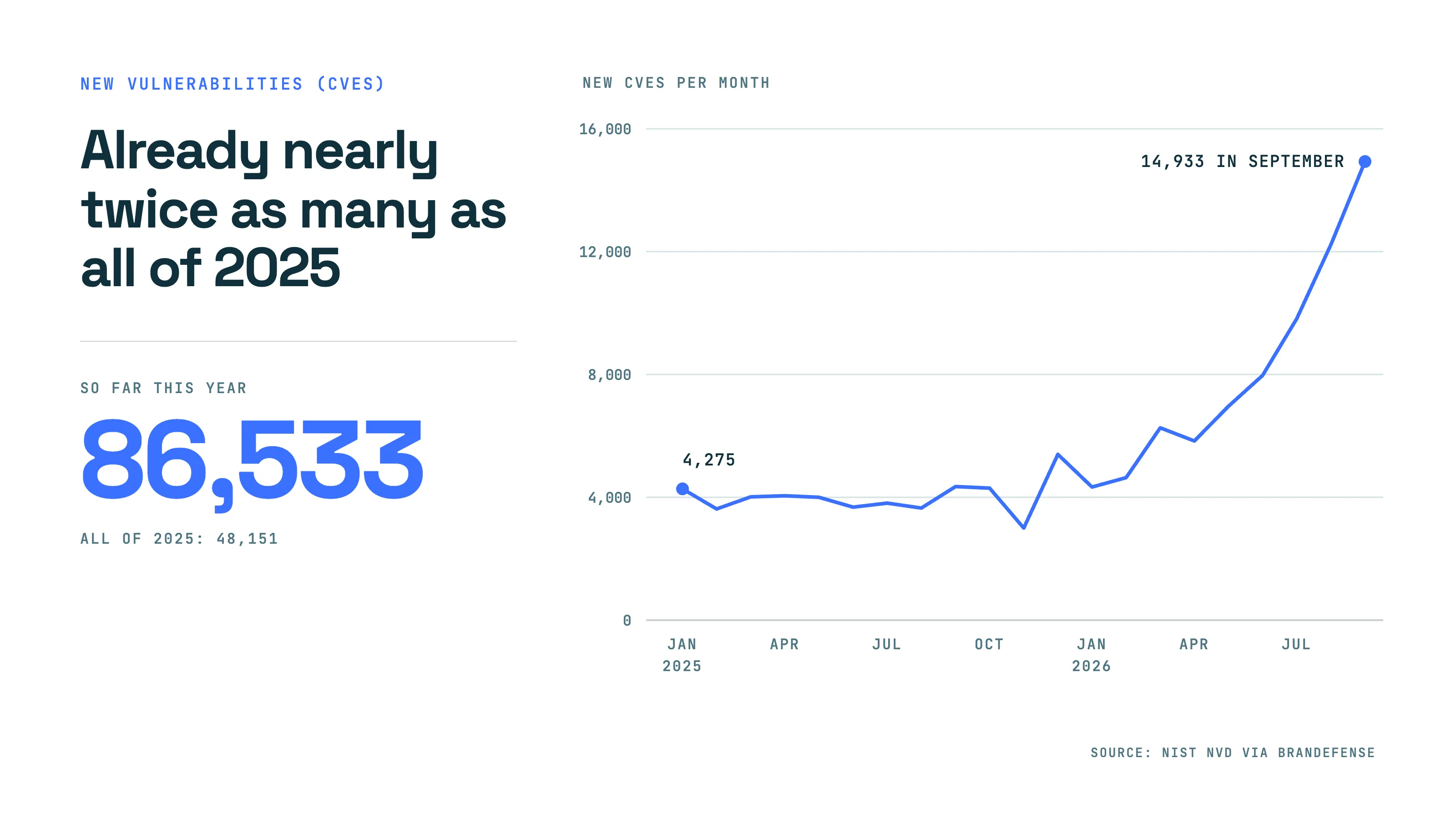
Known flaws are registered in CVE, a public catalogue that gives each vulnerability its own ID. About 48,000 new entries were added last year. This year there are already more than 86,000, according to the US National Vulnerability Database (NVD).
Most companies have scanners that compare their software with this catalogue and flag every match. But a match doesn’t tell you whether the flaw can actually be exploited in your environment. If developers investigated every warning, they would have time for little else.
We started at the other end
Everyone is using AI to find flaws faster, and in that race the attacker is always ahead. So we asked a different question: what does the defender know that the attacker never can? The answer is how your own software normally behaves.
Modern cloud software is built from hundreds of small, separately packaged parts called containers. bifrost maps every container: what it’s built from and how it behaves when it runs. The map is checked against the CVE catalogue several times a day, so you can see which flaws are real risks and which sit in code that never runs. In the best case, the list gets up to 90 percent shorter.
The same knowledge is used to write protection rules for each container automatically. Think of it as a key card that only opens the doors that part of the software needs. If an attacker takes it over, the card opens nothing new. The industry calls this runtime security. Because it’s based on how your software normally behaves, it can also stop attacks on flaws nobody has found yet.
bifrost connects to your existing development pipeline in about an hour, and most teams have a first picture within a day.
Four questions for leadership
Runtime protection buys time, but it doesn’t replace fixing the flaw. And since January, Sweden’s NIS2 law has made management accountable for cyber risk in the organisations it covers. The next time a critical flaw is announced, ask:
- Do we run the affected software?
- Where?
- Can it be exploited here?
- What do we do about it?
If your team can’t answer within an hour, we should talk. Contact bifrost →
A version of this article first appeared as a partner feature in Dagens Industri’s cybersecurity supplement, October 2026. Read the original in Swedish.
Tags
Do you know what's exploitable in your environment?
Deploy bifrost via Helm and it reads how every container is actually deployed, cutting your CVE list before a single line of code changes.