AI agents gone rogue
The July 2026 Hugging Face / OpenAI incident was driven end-to-end by an AI agent. We walk the RCE chain through the lens of runtime containment.
34 posts in this category
The July 2026 Hugging Face / OpenAI incident was driven end-to-end by an AI agent. We walk the RCE chain through the lens of runtime containment.
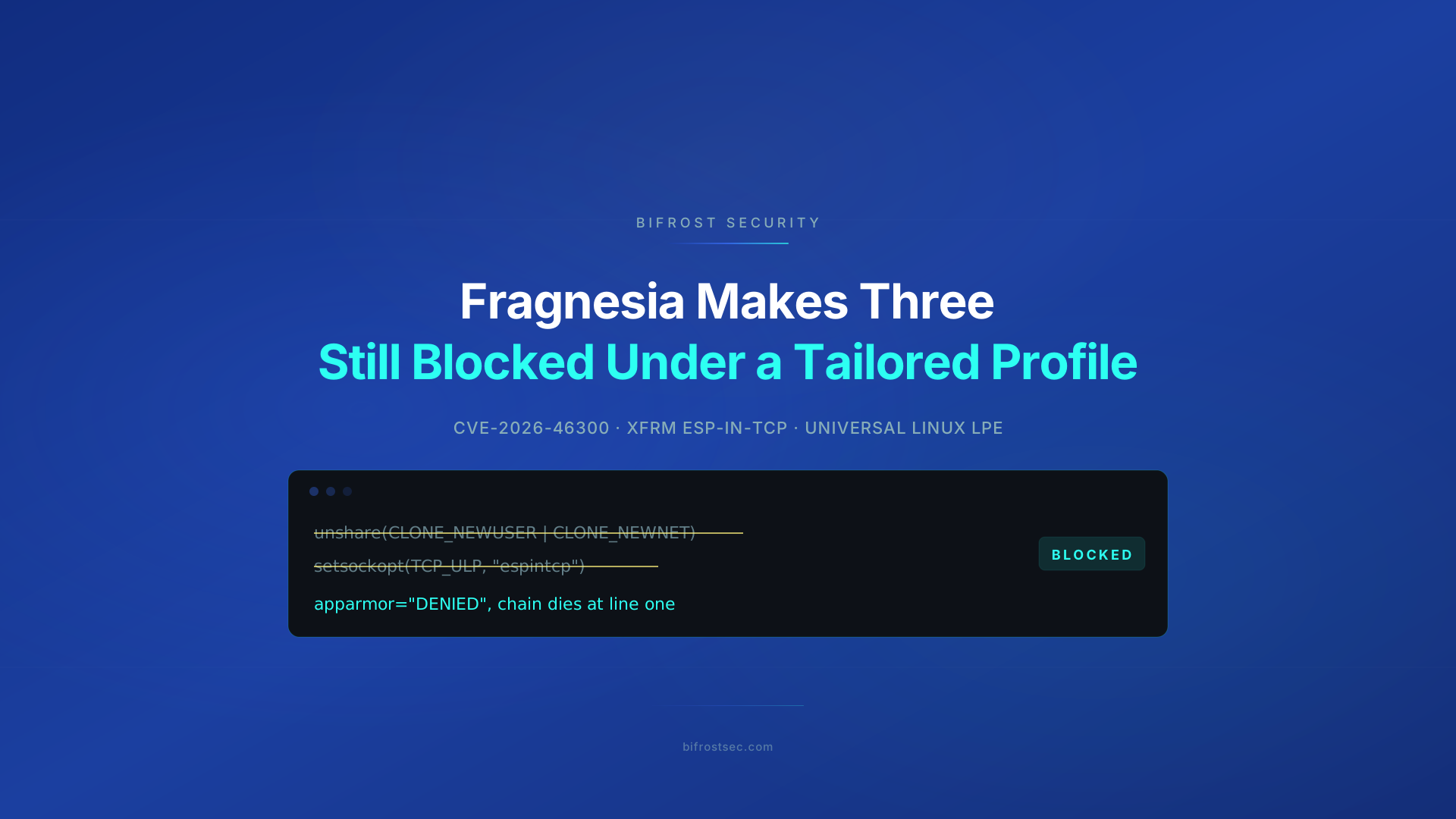
Fragnesia (CVE-2026-46300) is the third universal Linux kernel LPE in the Dirty Frag class to land in under two weeks. It abuses the XFRM ESP-in-TCP path to write into the page cache of read-only files with no race condition, and ships with a one-line public exploit. For workloads running under a behaviour-generated AppArmor profile, the surface it needs was never in the allow list. This is the same non-event, a third time. Here's why, and how to confirm your exposure in seconds.
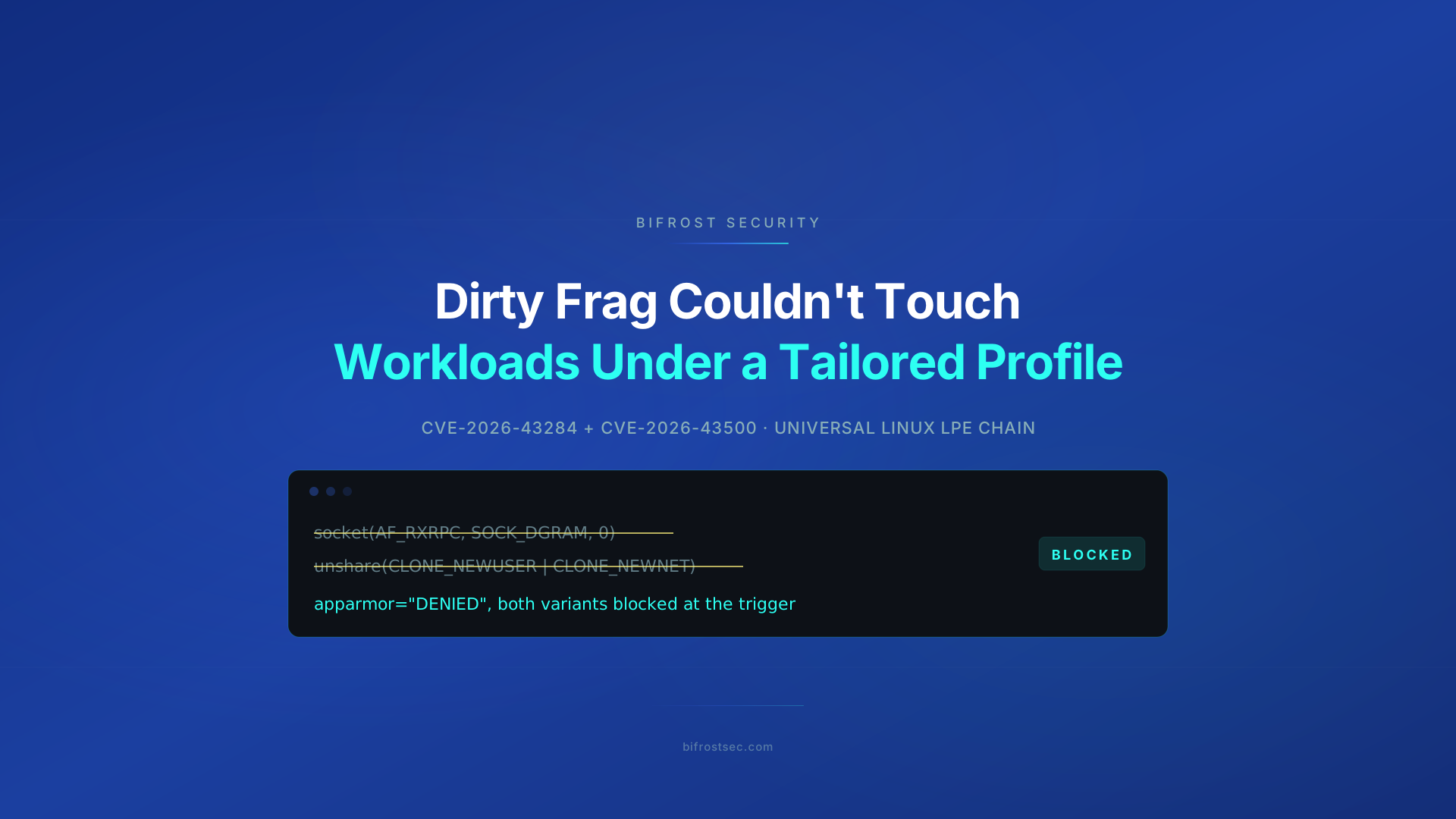
Dirty Frag is a universal Linux kernel LPE that chains two CVEs, CVE-2026-43284 and CVE-2026-43500, explicitly designed to bypass the Copy Fail mitigation. For workloads running under a behaviour-generated AppArmor profile, neither variant's required surface was ever in the allow list. Here's why, and how to confirm your exposure in seconds.
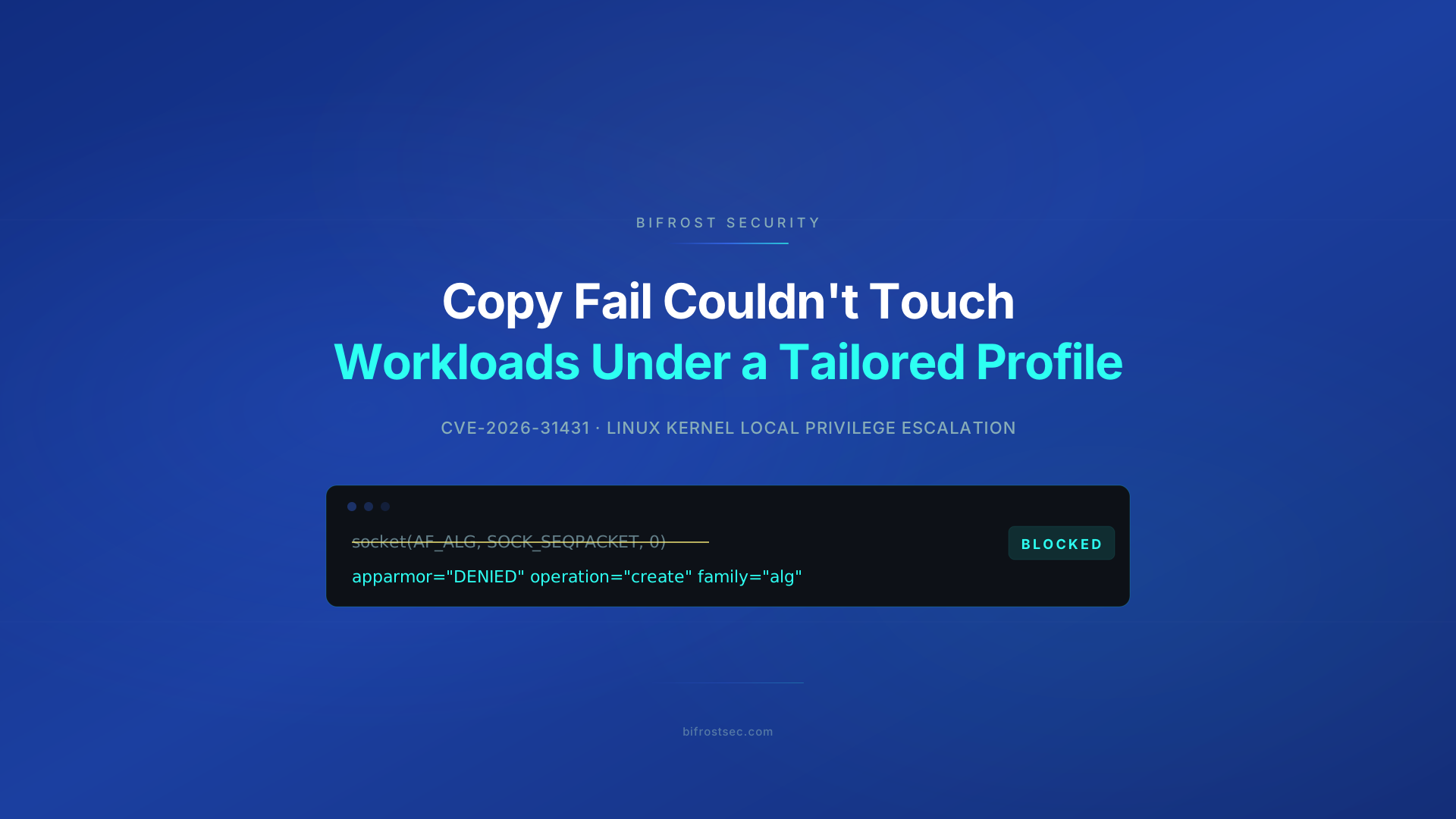
Copy Fail (CVE-2026-31431) is a Linux kernel LPE that's already in CISA KEV and reaches every container that inherits the AF_ALG kernel surface by default. For workloads running under a behaviour-generated AppArmor profile, the exploit's required syscall path was never allowed in the first place. Here's why, and how to confirm your exposure in seconds.
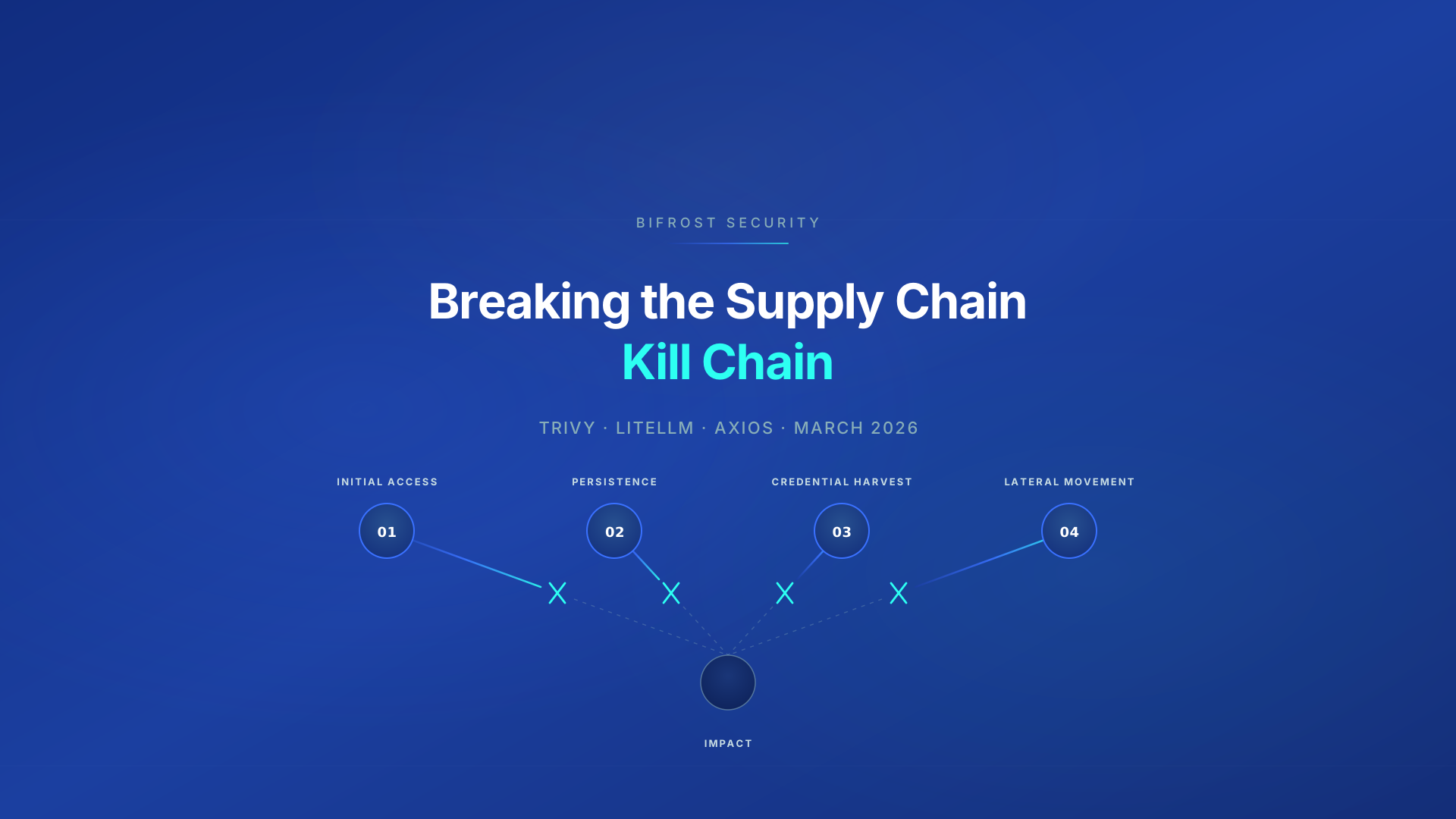
March 2026 saw five major supply chain attacks in twelve days. Map the kill chain behind the Trivy → LiteLLM cascade and the Axios npm compromise, then deploy five tactical defences that break the attack progression before it reaches your systems.
On April 22, 2026, @bitwarden/cli@2026.4.0 was published with a credential-stealing payload — via a GitHub Action that was itself compromised in the Checkmarx breach a month earlier. The cascade is not a metaphor; it is the mechanism. Why supply chain velocity is outpacing upstream defences, and why runtime enforcement is the only surface attackers cannot bypass.
In March 2026, the threat actor TeamPCP compromised Trivy, KICS, and LiteLLM — turning trusted security tools into credential stealers across thousands of CI/CD pipelines. We break down how the attacks cascaded, why traditional defences failed, and how tailored AppArmor profiles enforce runtime protection that stops compromised components regardless of how they were infected.
Qualys disclosed nine vulnerabilities in Linux's AppArmor module, collectively named CrackArmor, affecting every distribution shipping AppArmor by default. We break down what this means for managed Kubernetes workloads, assess the real exploitability, and outline what you should do now.
Modern container environments move fast, and so do attackers. Traditional security approaches based on signature matching or static detection rules are...
The shift from virtual machines to containers and Kubernetes fundamentally changed how software is built, shipped, and operated. Infrastructure became...
Linux sits at the heart of modern infrastructure: cloud platforms, edge devices, containers, and everything in between. With so much at stake, security can’t...
**When your container runtime is the target** RunC sits at the heart of nearly every container platform, from Docker and containerd to Kubernetes nodes. This...

Hallucinated dependencies become a vulnerability when attackers exploit common package names generated by AI models. This is called slopsquatting, and it is a...

AppArmor is a mandatory access control (MAC) Security Module that restricts the capabilities and permissions of a containerised workload. The permissions are...

Are you confident that every dependency in your codebase is secure? That quick-fix plugin four years ago that somehow became permanent? As the usage of...

Linux powers everything from cloud servers to smart devices. With so much depending on it, robust security is a must, and that’s where Linux Security Modules...

As Kubernetes continues to dominate container orchestration, securing your clusters is more critical than ever. While its flexibility and scalability make it a...

Linux powers everything from cloud servers to smart devices. With so much depending on it, robust security is a must — and that’s where **Linux Security...

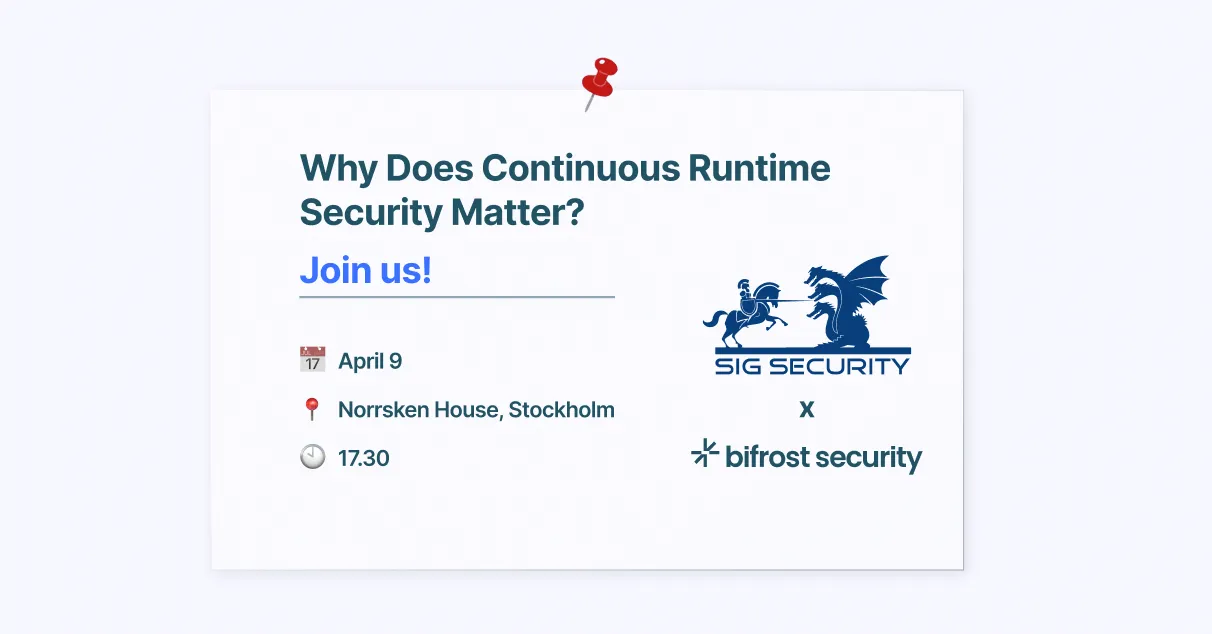
Sweden’s top network for IT security professionals is hosting an exciting session with the @bifrost team**. ** The session will explore how behavioural...

bifrost’s service leverages AppArmor, a Linux Security Module, to protect applications. But how does AppArmor work to protect your software? Let’s take a...

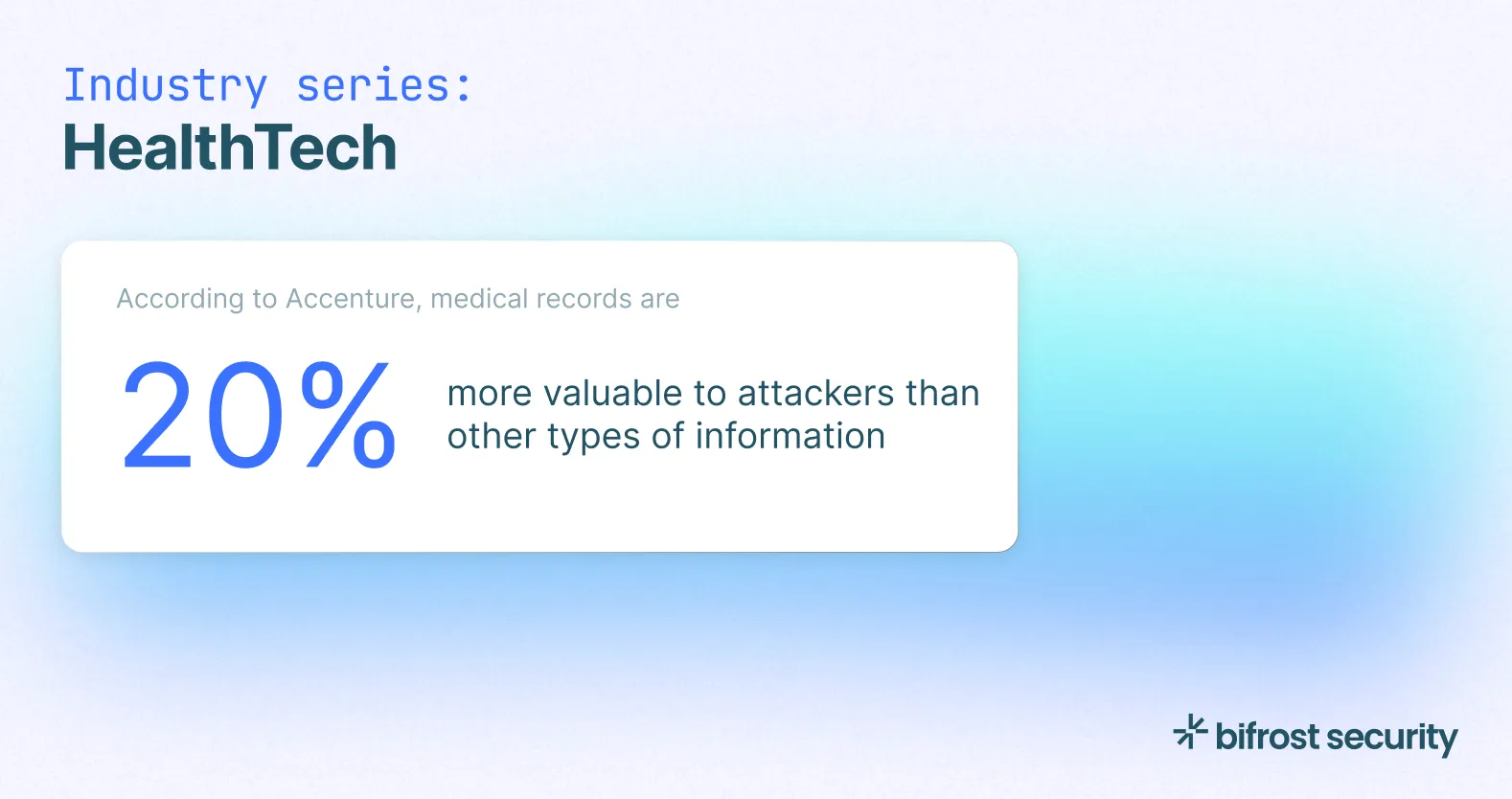
Over the last decade, software, cloud computing and AI have increasingly been incorporated into healthcare. This has caused healthcare to move to online...

Kubernetes providers make life easier for developers everywhere, especially for those of us wanting to use Kubernetes without the hassle of creating and...
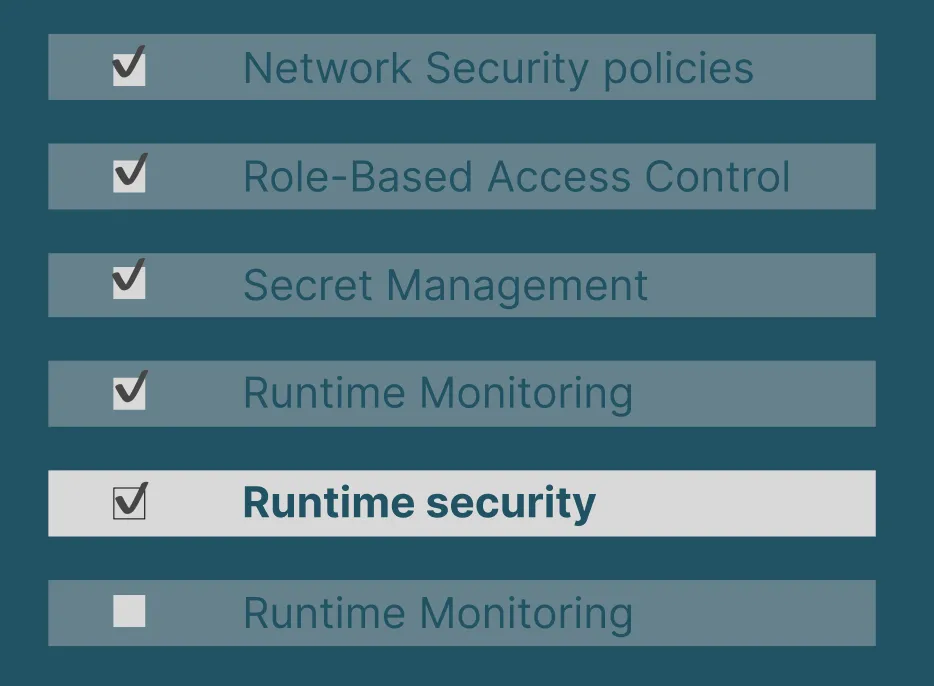
A comprehensive guide to securing your Kubernetes clusters in 2025, covering network policies, RBAC, secrets management, and runtime protection.

As 2024 has come to an end, we take a look back at last year's Kubernetes environment. In a recent study by Redhat, insights from 600 professionals across...
A deep dive into AppArmor, the Linux Security Module that powers Bifrost's container protection, and how it provides mandatory access control for your workloads.

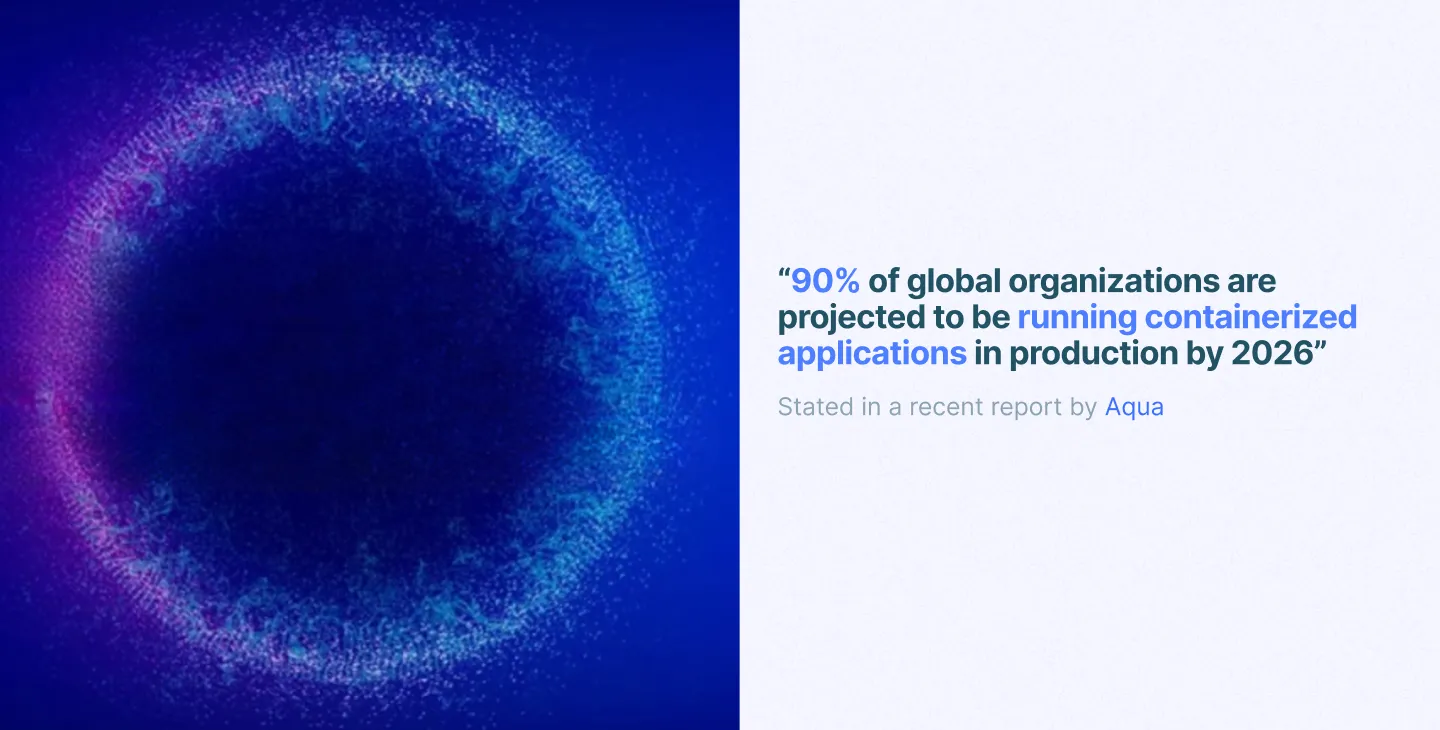
In the report “Protecting the Cloud Native Enterprise: Build the Foundation to Secure Your Containers in Runtime” by @Aqua, 90% of global organisations are...
bifrost’s service leverages AppArmor, a Linux Security Module, to protect applications. But how does AppArmor work to protect your software? Let’s take a...

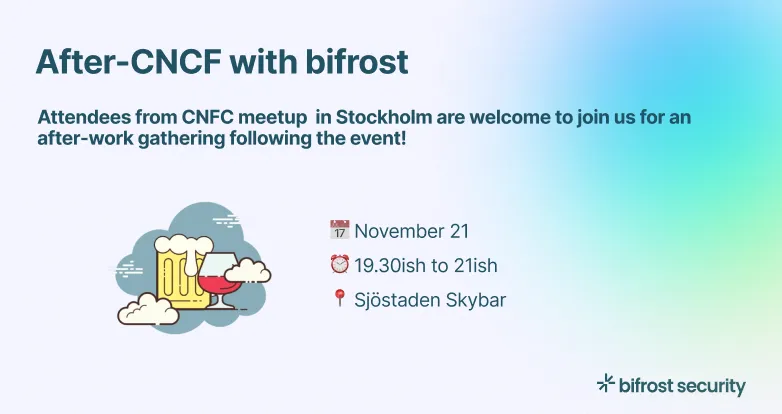
The Cloud Native Community Group - Meet up is approaching ☁️ bifrost’s very own CEO and Co-founder @Hannes Ullman is a speaker at the event. Don't miss out on...

Did you know 86% of organisations have known vulnerabilities deployed in their software? In many cloud attack incidents, intruders access data and disturb...

Kubernetes providers make life easier for developers everywhere, especially for those of us wanting to use Kubernetes without the hassle of creating and...

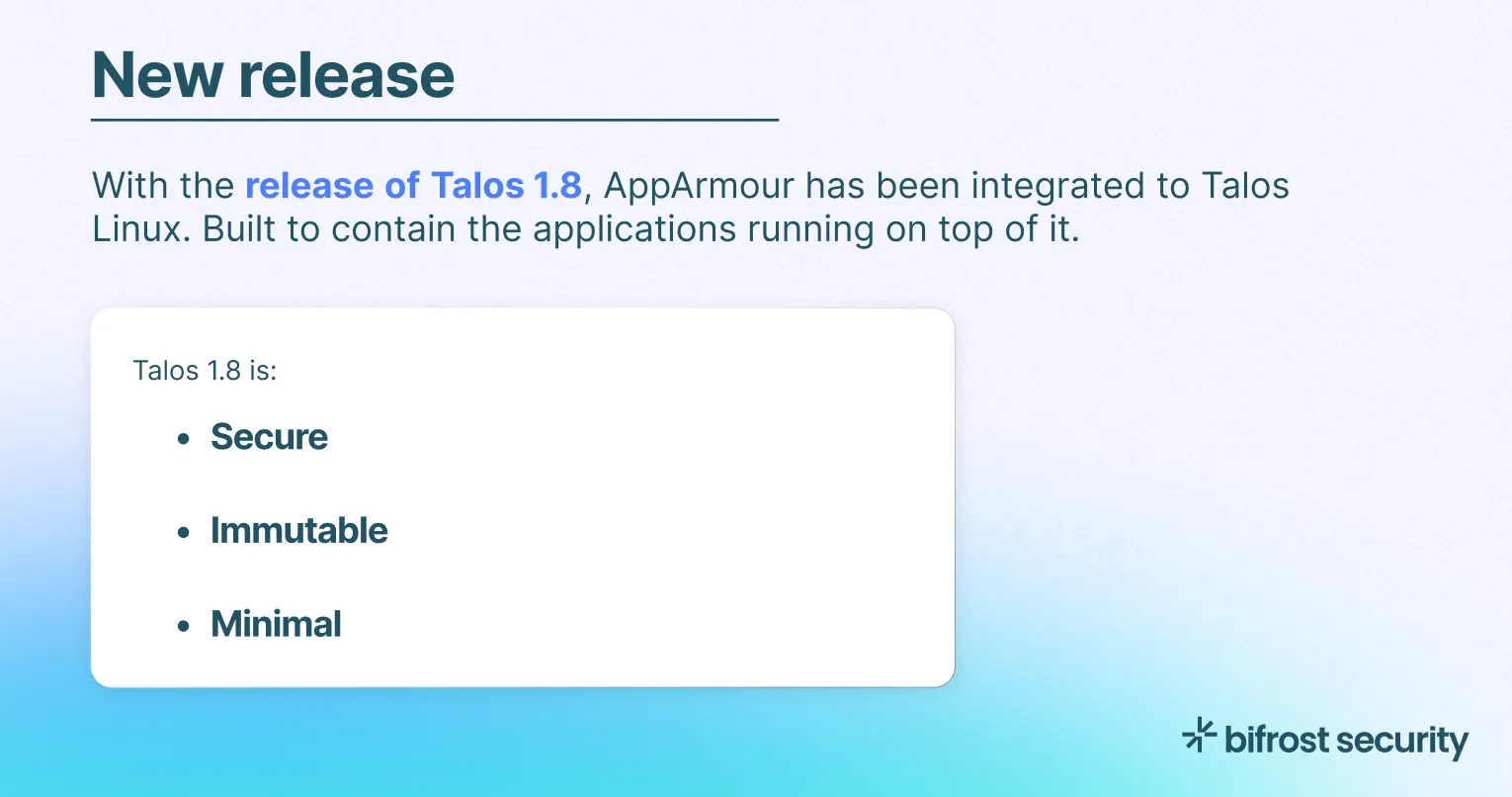
Today we celebrate the newest release of Talos Linux! Talos Linux is Linux reimagined for the kubernetes world. It is designed from the ground up with a...

Ensuring your containers and software are adequately protected is essential for any organisation. However, navigating the jungle of container security is quite...
bifrost security invites you to a virtual roundtable discussion this fall focused on the latest trends and strategies in container security. During the...